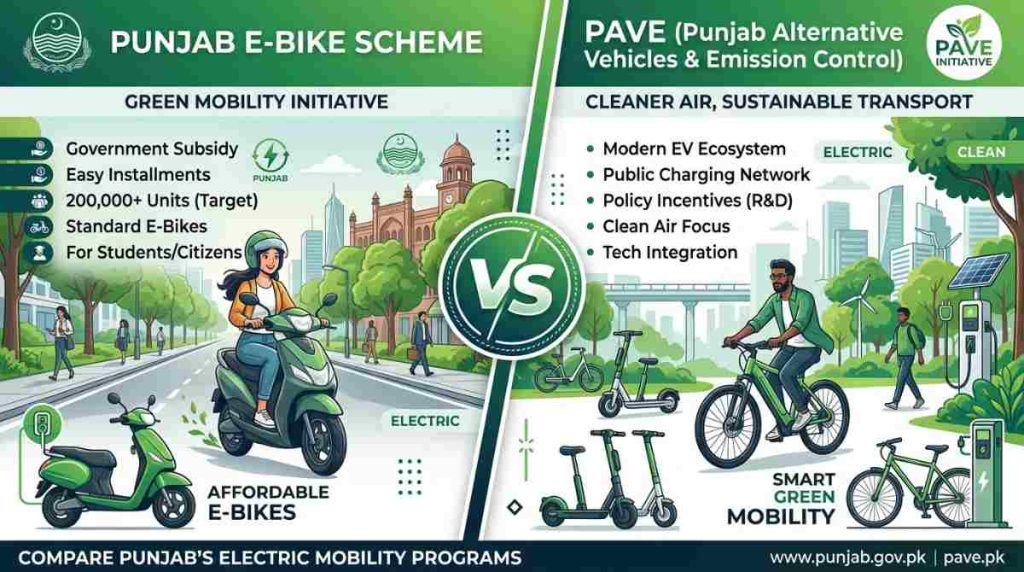
Punjab E-Bike Scheme vs PAVE at a Glance
| Feature | Punjab E-Bike Scheme | PAVE |
|---|---|---|
| Government level | Punjab Government | Federal Government |
| Main focus | E-bikes for eligible students | Electric two- and three-wheelers |
| Geographic scope | Punjab | Pakistan-wide |
| Main authority | Government of Punjab and relevant provincial institutions | Engineering Development Board / Federal Government |
| Application route | Punjab bike portal | PAVE portal |
| Eligibility | Punjab scheme-specific | PAVE phase-specific |
| Vehicle approval | Punjab scheme requirements | PAVE-approved vehicle catalogue |
| Current status | Depends on the applicable Punjab phase | FY 2025–26 first phase closed; Phase 2 to be announced |
Important: An application or vehicle approved under one program should not be assumed to qualify under the other.
What Is the Punjab E-Bike Scheme?
The Punjab E-Bike Scheme is a Punjab Government student mobility program designed to provide eligible students with access to electric bikes through a government-supported financing and subsidy arrangement.
The applicable phase determines the current eligibility requirements, available vehicles, quota, and application period.
For detailed requirements and to apply, see the Punjab E-Bike Scheme application guide.
What Is PAVE?
PAVE (Pakistan Accelerated Vehicle Electrification) is a federal electric-mobility program implemented through the Engineering Development Board.
Unlike the Punjab student scheme, PAVE is not limited to the Punjab student application route. Its first phase covered electric two-wheelers and three-wheelers and used computerized e-balloting for allocations.
The federal government reported 269,161 applications, with 40,000 electric two-wheelers and 1,000 electric three-wheelers allocated in the first e-balloting.
The first FY 2025–26 PAVE phase is closed. The Engineering Development Board states that the second phase will be announced through the official PAVE portal and EDB.
For PAVE vehicle eligibility, use the official electric vehicle catalogue.
Punjab E-Bike Scheme vs PAVE: What Is the Main Difference?
The biggest difference is who operates the program and who can apply.
The Punjab E-Bike Scheme is a provincial program focused primarily on eligible students in Punjab. PAVE is a federal electric-vehicle program with its own applicant categories and vehicle requirements.
Other differences include:
Do not use PAVE’s vehicle list or subsidy amount as evidence of eligibility under the Punjab scheme.
Is PAVE the Same as the PM Bike Scheme?
PAVE is the relevant federal electric-vehicle program when a government announcement identifies it by that name.
Searches for terms such as “PM bike scheme” can produce mixed results. Rather than relying on the search phrase, check the exact program name and authority in the official announcement.
If the notice refers to PAVE, use the official PAVE portal. If it refers to the Punjab Government’s e-bike scheme, use the Punjab bike portal.
What Is Punjab Green Credit for E-Bikes?
Green Credit is different from both the Punjab E-Bike Scheme and PAVE.
The Punjab Green Credit program provides rewards for verified environmentally positive activities. Its e-bike activity has separate purchase, usage, and evidence requirements.
Use the official Green Credit e-bike activity page for the current rules.
Do not assume that Green Credit can automatically be combined with a Punjab e-bike subsidy or PAVE benefit. Any combination should be confirmed under the applicable program rules.
Can You Apply for Punjab E-Bike Scheme and PAVE?
Do not treat one application as an application for both programs.
They use separate application systems and eligibility rules. If you may qualify for both, check the current terms of each program for restrictions on overlapping benefits, subsidized purchases, or duplicate assistance.
Similarly, do not add Punjab subsidy, PAVE subsidy, and Green Credit rewards together when calculating your expected benefit unless the official rules expressly allow it.
Which Official Portal Should You Use?
Use the portal that belongs to the program you are applying for:
Always verify that the information relates to the current phase or application window before submitting personal information.